Painting a Victorian House in London: A Specialist Guide
Victorian terraces make up a huge share of London''s housing stock — from the stucco crescents of Notting Hill to the pitch-roofed terraces of Greenwich and the mansion flats of Kensington. They are also the type of property most often painted badly. The building was designed to breathe, the joinery was hand-made, and the layers already on the walls tell a hundred-year story that modern plastic paint does not know how to sit on.
This is a practical guide to what actually matters when you paint a Victorian house in London, written from our own site experience.
1. Understand what you are painting on
Before choosing a colour, work out what is under the current coat.
- Lime plaster on walls and ceilings — soft, slightly powdery when scratched, often uneven.
- Original softwood joinery — sash windows, deep skirtings, panelled doors, dado and picture rails.
- Cast iron radiators and rainwater goods — usually painted many times, often flaking.
- Stucco or brick facades — either painted masonry (Notting Hill, Pimlico, Belgravia) or exposed London stock brick (Hackney, Islington, Camberwell).
2. Sash windows: restore, do not just repaint
Almost every Victorian house we work on has original sashes. The common failure is painting them shut, sealing the parting bead and gumming up the pulleys.
Our sequence:
1. Ease the sashes and drop the weights so cords can be checked and replaced. 2. Strip failing paint back to sound layers — never to bare wood if the existing paint is stable. 3. Fill open joints with linseed putty, not filler; putty flexes with the frame. 4. Prime bare timber with an oil-based wood primer. 5. Two coats of a specialist sash and casement paint — we typically use Little Greene Intelligent Gloss or Farrow & Ball Exterior Eggshell. 6. Cut cleanly against the glass with a 1" sash brush and razor off any overspill before it cures.
Full sash restoration takes a full day per window with two decorators; anyone quoting an hour per sash is spraying and moving on.
3. Lime plaster walls need breathable paint
Modern vinyl and acrylic emulsions form a plastic film. On a lime plaster wall in a solid-wall Victorian building, that film traps moisture behind it and lifts off within a couple of winters — usually in patches around chimney breasts and external walls.
The fix is a breathable paint. Our standard specification:
- Farrow & Ball Estate Emulsion — chalky matt finish, high pigment load, and vapour-open enough for most well-maintained interiors.
- Little Greene Intelligent Matt Emulsion — same breathability with a slightly tougher wipeable surface, useful in hallways.
- Bauwerk Colour or Edward Bulmer — true lime-based paints for houses with active moisture movement.
4. Colour: period-accurate without being a museum
Victorian interiors were not white. Rooms were painted in deep, saturated colours calibrated to gaslight — muddy greens, oxblood reds, warm stones, inky blues. That does not mean you have to live in one, but the proportions of a Victorian room work best when the colour has some depth.
Palettes we specify most often on London Victorian jobs:
- Chelsea and Belgravia drawing rooms — Farrow & Ball Tallow 203, Setting Plaster, Skimming Stone, or a full Hague Blue statement wall with Strong White trim.
- Kensington hallways and staircases — Little Greene French Grey Mid, Farrow & Ball Cornforth White, with woodwork in Estate Eggshell.
- Greenwich and Blackheath cottages — Farrow & Ball Green Smoke, Pigeon, or De Nimes with warm off-white ceilings.
- Islington and Hackney terraces — bolder combinations: Down Pipe kitchens, Bancha studies, Card Room Green panelling.
5. Facades and stucco
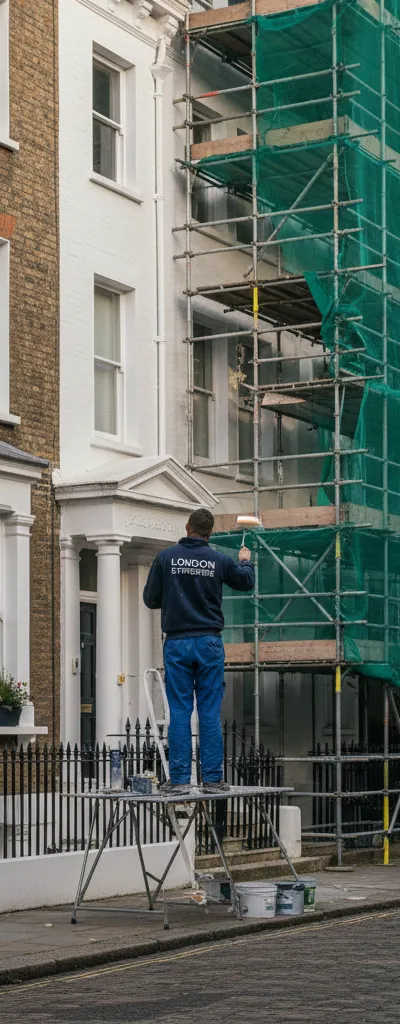
Stucco fronts across Belgravia, Pimlico, Notting Hill and parts of Kensington need a masonry paint that is flexible enough to move with the substrate. Our default is Sandtex 365 Ultra Smooth on prepared stucco after a full strip-back of any flaking paint, crack-stitching where the render has moved, and a coat of stabilising solution on chalky patches.
For exposed London stock brick fronts, our advice is almost always the same: do not paint them. Once painted, brick has to be maintained forever. We spend more time removing brick paint from Hackney and Islington fronts than applying it.
6. Damp: solve it before you paint
The most expensive mistake on a Victorian repaint is painting over damp. Rising damp, blocked airbricks, high external ground levels and blown cement render all cause paint to fail from behind. If a wall is showing tide marks, salt bloom or blown plaster, get the cause diagnosed and fixed before we touch it. Painting over damp buys you six months.
7. What a proper Victorian repaint costs
There is no shortcut. A three-storey Victorian terrace refresh — walls, ceilings, all woodwork, hall stairs and landing — is typically a three to four week job for a two-decorator team. Full sash restoration adds one to two weeks depending on the number of windows. Exterior stucco and sashes together are usually a separate mobilisation with scaffolding.
If a quote for the same scope is materially cheaper than that, something is being skipped — almost always preparation, primer, or the sashes.
Where we work on Victorian properties
We paint Victorian houses across London every week. The heaviest concentration of period work we take on is in:
- Chelsea — Cheyne Walk, Tite Street, Old Church Street terraces
- Kensington — Phillimore Gardens, Campden Hill, Holland Park stucco
- Belgravia — Eaton Square, Chester Row, Wilton Crescent
- Notting Hill — Lansdowne Crescent, Elgin Crescent, Ladbroke Grove
- Greenwich — Ashburnham Triangle, Gloucester Circus, Blackheath borders
- Islington — Canonbury Square, Barnsbury, Highbury Fields terraces
- Hackney — De Beauvoir, London Fields, Clapton period conversions
Ready to plan yours?
Every Victorian project starts with a proper site visit — we walk the house with you, test the existing paint, check the sashes and the plaster, and specify the exact products room by room. Request a quote and we will book a visit within a few working days.
Practising London painters & decorators since 2019 — every guide is written and reviewed by our working team. About the authors →